Is it the right AI project? Find out before you spend.
Maybe a consultant has sent you a proposal, or someone on your team has started building something with AI. From where you sit it's hard to tell whether it's the right project, what it will cost, and what it could put at risk, from your intellectual property to your reputation. I help owners and leadership teams of mid-sized companies make that call, and I help companies building AI products decide what to build first.
For more than twenty years I've led products from Documentum to GitHub, and the work has always come down to deciding what's worth building. At GitHub that included the tests Copilot Chat had to pass before it shipped. More about me
There's no pitch on the call. If I'm not the right person for your problem, I'll introduce you to someone who is.
Why now
Choosing well matters more than it used to.
A small team can now build in weeks what used to take a year. That speed also lets a company pour months of its people's time and money into the wrong project before anyone stops to ask.
"Choosing what not to build is actually a far more important decision than deciding what to build."
Jeetu Patel, Chief Product Officer, Cisco, on HBR IdeaCast, October 2026
"The problem, however, is not that AI does not work. The problem is how leaders think about it."
David De Cremer, Dean, D'Amore-McKim School of Business, Northeastern University, Harvard Business Review, July 2026
How I help
Ways to work together
"A consultant has quoted us for an AI project. Is it worth doing?"
AI project review
I read what's been written about one proposal or project, talk with the people doing the work and spend a couple of hours with you. You get a short written assessment of its likely cost and risks, and what I would do in your place. Most people start here.
Fixed fee · about two weeks
"We're building AI infrastructure. Which customers should we build for first?"
Customer discovery and product shaping
For companies whose product is AI or the infrastructure under it. I talk with the customers you want to win and find the problems they will pay to have solved. Then I work with your engineers to shape a first version around those problems.
Monthly
"Our owners and board want to know what we're doing about AI."
Monthly retainer
Each month we pick one piece of work, such as reviewing the AI tools you already use or writing a plan your board can stand behind. I lead it, your team or partners I introduce do any building, and I work alongside your counsel on legal questions.
Monthly · continues while it's worth your while
"Someone needs to own this, but we can't justify a full-time hire."
Fractional AI executive
I join your leadership team for a few days a month and own the AI agenda while you hire a full-time leader, or while you work out whether you need one. We write the handoff plan in the first week, so everyone knows how it ends.
A few days a month
"We'd like someone to think these decisions through with us."
Advisor
A standing conversation with your CEO or board whenever an AI decision comes up. Nobody has to prepare slides.
Regular calls
About
Hi, I'm Craig.
I trained as a geologist and built statistical models before spending more than twenty years leading products that engineers build on, from cloud and containers to developer tools and now AI. I see technology as a mix of physical, economic and human parts that tends to favor some people over others, so with any AI project I start by asking who gains and who carries the risk.
Most of my job has been getting engineering, sales, support, legal and customers to share one plan and stick with it until something ships, which is where AI projects inside a company usually stall. Much of it was enterprise software, where nothing sells until it passes a security review and leaves a record an auditor can follow. AI tools raise those same questions.
Deciding when AI is ready to ship. At GitHub (2022 to 2025) I built the evaluation and safety tests Copilot Chat had to pass before it reached every paying Copilot customer.
Growing a product while its costs fell. I led GitHub Codespaces, where daily use grew a thousandfold in a year as the cost per hour fell to a tenth. GitHub later carried its workspace technology into Actions to run Copilot's coding agent.
Leading across large organizations. At Microsoft (2018 to 2021) I led work across Azure teams on the Kubernetes platform that OpenAI ran its research on and most of Azure's AI services are built on.
Changing a company's direction. At Mirantis (2014 to 2017) I led the product and partner teams that moved its cloud platform onto Kubernetes, working with Google, Microsoft and Ericsson.
Building an enterprise platform. At EMC Documentum (2004 to 2011) I helped build xCP, a process management suite for regulated industries that need an audit trail for every decision. It made Gartner's Magic Quadrant, and CNAM, France's national health insurance fund, ran its nationwide reimbursement processing on it.
Working with universities and research groups. As a research fellow at MIT I helped design the IT curriculum for the new Malaysia University of Science and Technology. Earlier I built systems for researchers at Columbia's Lamont-Doherty Earth Observatory.
I've also led product at ThisWay Global, JFrog, Yahoo!, HGST and Strava, and I mentor startups at Berkeley SkyDeck. I live in the San Francisco Bay Area. Full background on LinkedIn.
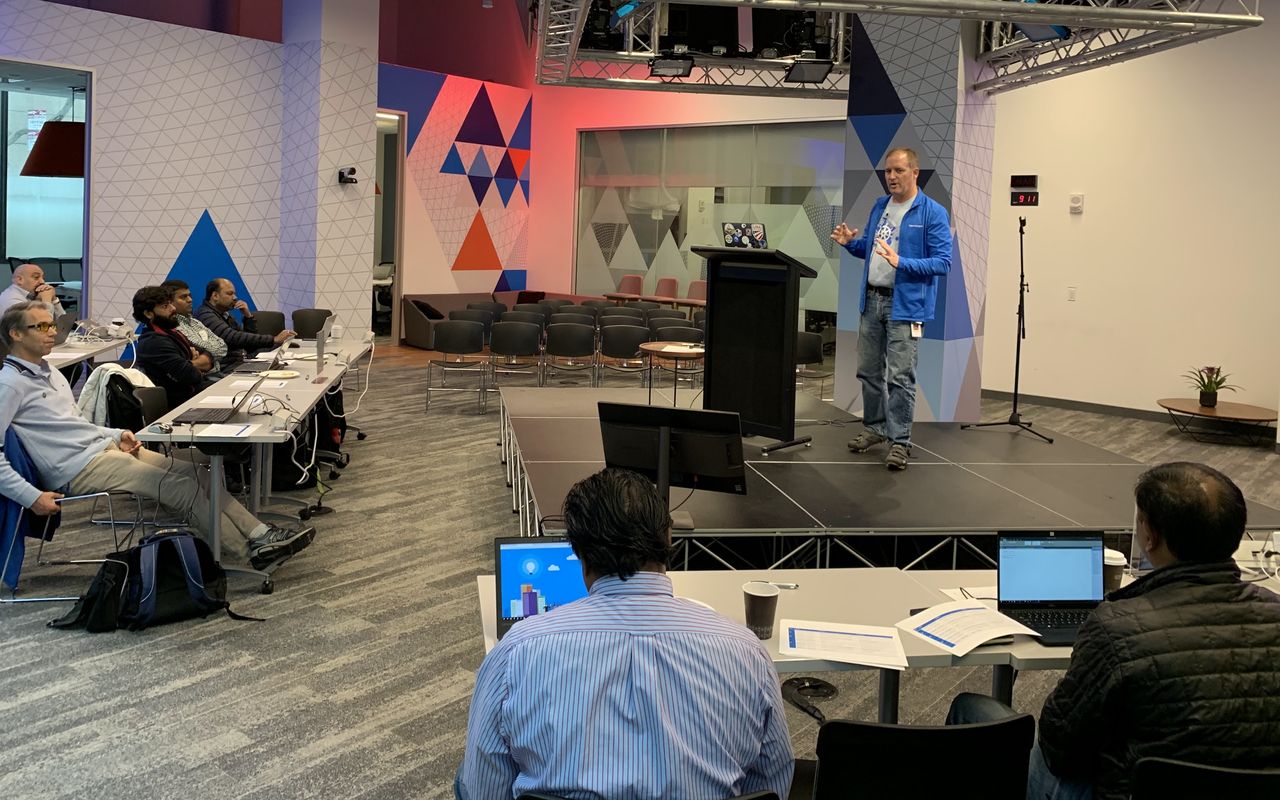
Leading a session for an executive audience at Microsoft.
Resources
Reading and reference
My reading list covers deciding what's worth building and what careful research says about AI at work. I also track upcoming AI rules, each with its official source and a few questions to check whether it affects you. The next two are below.
End of the EU grace period for labelling AI-generated content in systems already on the market.
Colorado's new law on automated decisions takes effect, and California's rules on automated decision-making start to apply. Both ask for notice, an explanation and a way to appeal, so one process can often serve both. Build it to also cover rules already in force, such as New York City's bias audits for hiring tools, Illinois's notice rules for AI in employment, California's anti-bias rules for hiring software, and the right to opt out of profiling under many state privacy laws.
California's rules for customer-service chatbots at large businesses take effect, asking them to tell customers when they are talking to a bot and to make a good-faith effort to put them through to a person who asks for one.
California employers may no longer rely on an automated system alone to discipline or dismiss someone, and a person has to review those decisions.
EU AI Act duties for high-risk uses such as hiring, credit and education begin.
California risk assessments are due for automated processing you already do.